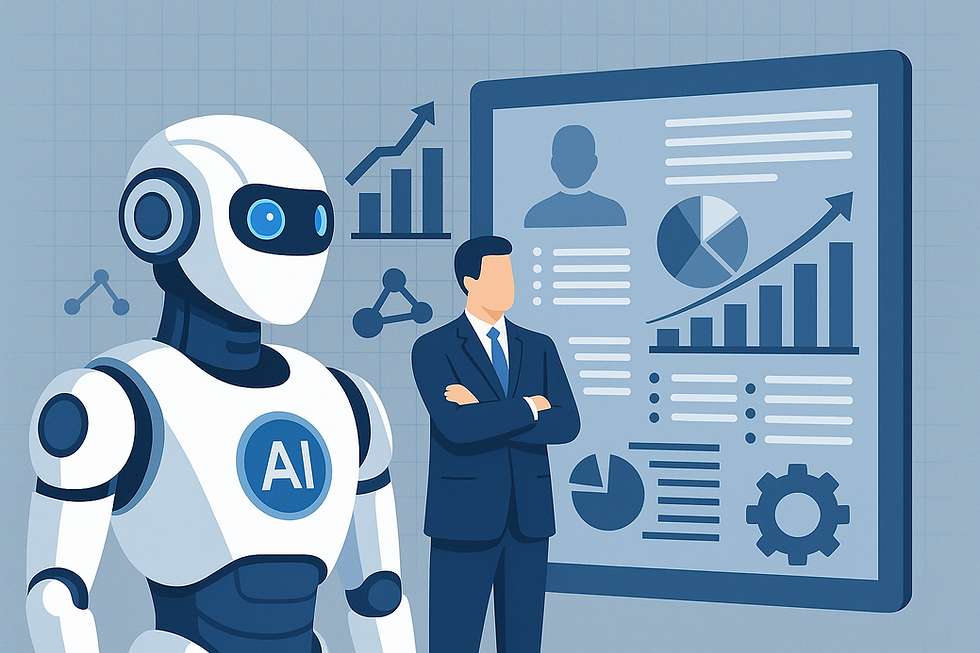
The New HR for AI: Managing Metrics, Bias, and Bot Maintenance
In traditional management, performance reviews are a cornerstone of organizational growth. They’re how we measure success, identify development areas, and guide employee progression. But in the age of AI, bots are increasingly taking on work once performed by people—from handling customer inquiries to optimizing logistics networks and operating robotic arms on factory floors.
So what happens when "employees" don’t eat lunch, take PTO, or attend team-building retreats, but still affect customer satisfaction, product quality, and operational efficiency? How do we hold bots accountable?

In this article, we’ll explore how performance management must evolve when AI-powered systems become part of the team. We’ll look at:
The mechanics of reviewing bots
The risks of algorithmic drift and decay
How bias in AI can distort outcomes
What KPIs look like in AI-augmented industries like manufacturing, customer service, and logistics
Bots on the Org Chart
It might sound strange to think about performance reviews for non-human agents. But when bots produce real outputs that impact business results, they must be measured and managed.
Performance reviews for bots aren't about motivation or career paths. They're about:
Evaluating accuracy, reliability, and scalability
Monitoring degradation over time ("model decay")
Identifying bias and unintended behavior
Maintaining alignment with company goals and ethical standards
In short, performance reviews for bots are risk management tools disguised as operational assessments.
Key Concepts in Bot Performance
1. Algorithmic Drift
Over time, AI systems can become less accurate as their training data diverges from real-world inputs. This is especially true in dynamic environments.
2. Hallucinations
In generative AI, hallucinations occur when the system fabricates incorrect or misleading information. These errors are often confidently presented, making them harder to detect.
3. Model Decay
Even without new input data, models can degrade due to shifts in behavior patterns, seasonality, or systemic noise. Regular re-training is necessary.
4. Bias and Fairness
AI systems often inherit bias from their training data. If left unchecked, this can perpetuate discrimination or deliver suboptimal outcomes to specific groups.
Industry Applications
Manufacturing: Robot Arms and Predictive Maintenance
In factories, robotic arms execute repetitive tasks like welding, assembling, or painting. AI systems also predict when equipment needs maintenance.
Performance Metrics:
Uptime / Downtime
Defect rate
Mean time between failures (MTBF)
Energy efficiency
Leadership Implications:
Bots must be continuously calibrated.
Managers must work closely with engineers to review output logs and error rates.
Performance reviews here are data-driven audits, often visualized through dashboards.
Emerging Issue:
If a robot consistently underperforms or introduces product flaws, do you retrain the system, upgrade the hardware, or reassign the task? Leadership decisions here mirror HR talent strategies, but with machines.
Customer Service: AI Chatbots and Virtual Agents
Customer service bots resolve inquiries, guide users through processes, and deflect support volume from human agents.
Performance Metrics:
First-contact resolution rate
Escalation rate to human agents
Customer satisfaction (CSAT) scores
Response time consistency
Leadership Implications:
Managers must test bots regularly using real-world queries.
Misleading responses or poor tone can erode brand trust.
Chatbots must be re-tuned with changing FAQs, policies, and product updates.
Emerging Issue:
Hallucinations are a real risk. If a chatbot provides incorrect refund policies or makes unauthorized commitments, leaders must act fast to revise scripts and implement tighter governance.
Logistics: Routing Optimization and Predictive Planning Bots
AI is used to plan delivery routes, allocate warehouse resources, and predict inventory demand.
Performance Metrics:
Delivery time adherence
Cost per delivery mile
On-time-in-full (OTIF) rate
Route efficiency index
Leadership Implications:
Leaders need to identify when poor performance is due to flawed AI or uncontrollable factors (e.g., weather, traffic).
KPIs must be reviewed with context, not just numbers.
Bots must be retrained with new logistics data regularly.
Emerging Issue:
Routing algorithms may prioritize efficiency over fairness—e.g., consistently delaying certain neighborhoods. This creates reputational risk if not caught.
Redesigning KPIs for a Bot-Enhanced Workforce
Traditional performance metrics focus on:
Output volume
Quality of work
Behavioral competencies
Collaboration and culture fit
Bot performance metrics must instead focus on:
Accuracy and reliability
Response time and consistency
Error rates and exception handling
Training data relevance and model drift
System compatibility and uptime
Blended Metrics:
In hybrid teams, some KPIs must measure collaborative performance:
How well does the bot integrate with human workflows? Are humans able to trust and act on AI outputs? Do bots reduce or increase cognitive load?
Leadership Responsibilities in Performance Management
1. Bot Lifecycle Ownership
Leaders must oversee the full lifecycle:
Selection and procurement
Deployment and training
Monitoring and tuning
Retirement or replacement
This parallels the employee lifecycle—with key differences in timelines and triggers.
2. AI Ops Integration
AI operations (AI Ops) must be embedded into standard business reviews. Leaders should expect regular reporting on bot performance, similar to human workforce dashboards.
3. Error Escalation and Intervention Protocols
Every bot should have a defined chain of accountability. Who monitors it? Who steps in during failure? When is it escalated to human decision-makers?
4. Bias Audits
Performance reviews must include fairness assessments:
Are certain customer segments receiving worse service from bots?
Are hiring or routing decisions skewed unfairly?
Leaders must own bias mitigation alongside technical teams.
Tools for Bot Performance Management
Monitoring Dashboards: Real-time views of bot metrics.
Synthetic Testing: Simulated queries to stress test bots.
Human-in-the-loop Systems: Ensure humans oversee key decision points.
Explainability Tools: Understand why bots made certain decisions.
Reinforcement Learning Feedback Loops: Use outcomes to improve future performance.
Cultural Impacts
If bots are above review, human teams may lose trust in automation. Leaders must:
Treat bots with the same scrutiny as humans
Promote transparency in performance data
Involve employees in feedback and optimization
This builds a culture where AI is a partner, not a black-box overlord.
The Evolution of Performance Management
In the age of AI, performance management doesn’t disappear but evolves. Leaders must design systems that evaluate bots not only by output, but by impact, bias, and collaboration quality. This requires new KPIs, new habits, and a mindset shift:
You don’t manage bots with charisma—you manage them with clarity.
This is the fifth article in our series "Leadership in the Age of AI Bots." In the next article, we’ll explore the cultural side: what happens to team morale, trust, and inclusion when bots become colleagues? And how can leaders protect what makes workplaces human?